There is no single best martial art for every child. Karate, Taekwondo, and Jiu-Jitsu can all offer valuable training, but they typically emphasize different kinds of movement and partner interaction. The better choice depends on your child, the instructor, the specific school, and how the program is actually taught.
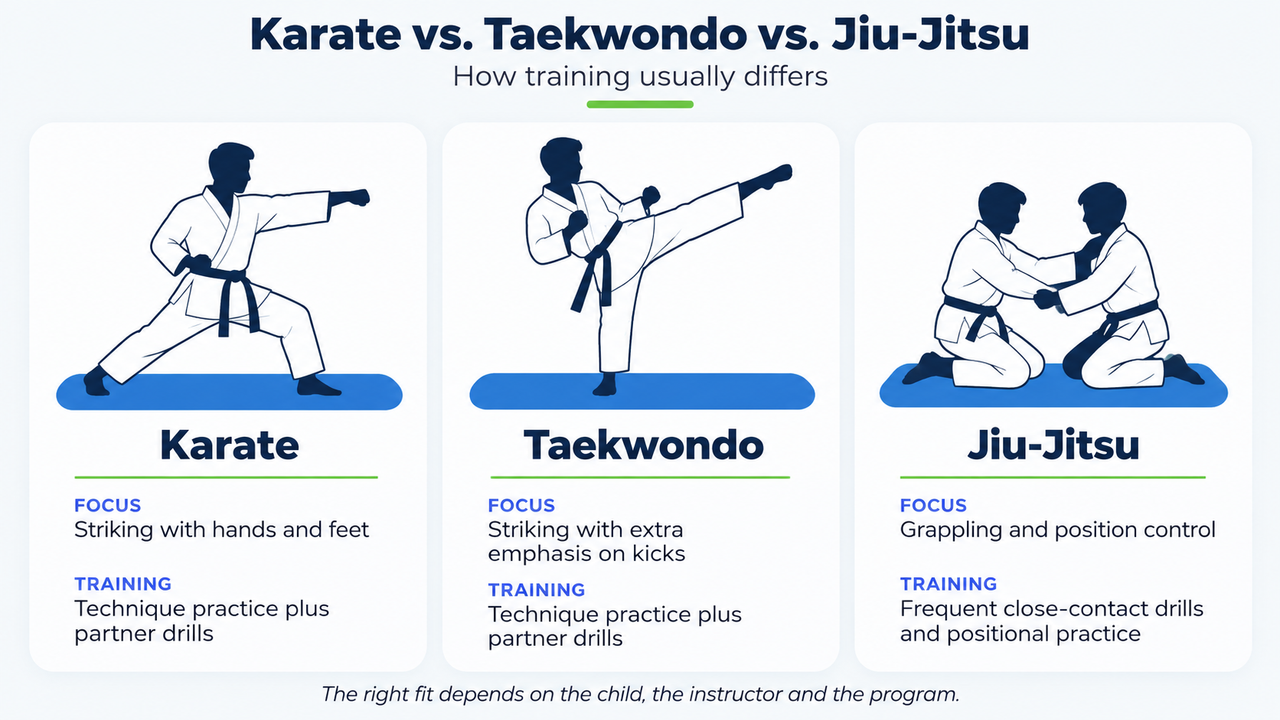
As a simple starting point: karate often combines hand and foot striking with structured fundamentals; Taekwondo commonly places greater emphasis on kicking; and Jiu-Jitsu generally focuses much more on grappling and ground-based control.
But do not choose from those descriptions alone. Two schools teaching the same martial art can give a child very different experiences.

Quick Comparison: Karate vs. Taekwondo vs. Jiu-Jitsu for Kids
| Question | Karate | Taekwondo | Jiu-Jitsu |
|---|---|---|---|
| Typical technical emphasis | Striking fundamentals using hands and feet; exact balance varies by style | Striking with a particularly strong emphasis on kicks | Grappling, positional control, and submission-oriented techniques |
| Common training relationship | Individual technique plus partner work; contact varies | Individual technique plus partner work; contact varies | Frequent close-contact partner grappling |
| Competition | Depends on school/style; forms and/or sparring may be available | Often includes forms and kicking-oriented sparring under rulesets | Often includes live grappling/rolling and positional competition |
| Best for... | Depends on the child and the actual program—not the label alone. |
The American Academy of Pediatrics similarly distinguishes the styles by broad technical focus: karate primarily emphasizes strikes, Taekwondo tends to place somewhat greater emphasis on foot strikes, and judo/Jiu-Jitsu commonly include grappling and tackling. The AAP also emphasizes that injury patterns and safety depend on the type and level of martial arts being practiced.
Karate for Kids: What Is It Usually Like?
Karate is a Japanese martial arts tradition with many styles and school systems. In broad terms, children's karate often includes structured practice of stances, movement, blocks, hand techniques, kicks, combinations, and progressive skill development.
Depending on the school, students may also practice forms, partner drills, self-defense, pad work, sparring, competition, or other activities.
That variation matters. Asking “Does karate spar?” or “Does karate teach self-defense?” cannot be answered accurately for every school with one universal yes or no.
For parents, karate may be worth exploring if the child enjoys a mix of individual technical practice and structured partner work—but the actual class should determine the fit.
Taekwondo for Kids: What Is It Usually Like?
Taekwondo is a Korean martial art that can look similar to karate to a new parent, but it typically places greater emphasis on kicking techniques.
Children may practice stances, kicks, hand techniques, forms, drills, and—depending on the school and ruleset—sparring or competition.
A child who enjoys dynamic kicking and athletic movement may find that appealing. But again, “Taekwondo” on the sign does not tell you the entire experience. One school may emphasize recreation and fundamentals; another may have a stronger competition focus.
The instructor, class culture, and contact rules still matter.
Jiu-Jitsu for Kids: What Is It Usually Like?
Jiu-Jitsu programs generally place much more emphasis on grappling than karate or Taekwondo. Students commonly learn how to work from different positions, control an opponent or partner, escape positions, and apply techniques in close physical contact.
Many children enjoy the problem-solving aspect of grappling and the immediate feedback that comes from working with a partner.
Parents should understand that close-contact training is a normal part of the experience in many Jiu-Jitsu schools. They should ask how beginners are introduced to partner work, how children are matched, what techniques are permitted by age, and how tapping/stopping rules are taught and enforced.
As with striking arts, safety depends heavily on instruction and program design.
Which Is Better for Discipline: Karate, Taekwondo, or Jiu-Jitsu?
No style name can guarantee better discipline.
Discipline is affected by what instructors expect, how consistently expectations are enforced, whether children are taught to take responsibility, and whether the environment rewards effort and control.
A well-run Jiu-Jitsu program may teach stronger habits than a poorly run karate program. A well-run Taekwondo school may be more structured than another school using the same Taekwondo label.
Instead of asking which martial art “has discipline,” watch the class and ask how discipline is actually taught.
Related: how martial arts can help kids practice self-discipline
Which Is Better for Confidence?
Confidence is also not owned by one martial art.
Children can build confidence when they experience manageable challenges, receive useful feedback, see progress, and learn that mistakes do not end the process.
Those experiences can happen in karate, Taekwondo, or Jiu-Jitsu. Whether they actually happen depends on the learning environment.
If a school humiliates beginners, compares children constantly, or makes rank the only source of worth, the style name will not fix the teaching.
Related: how martial arts can help build real confidence in kids
Which Is Better for Self-Defense?
Each art can teach useful physical skills, but self-defense is broader than a catalog of techniques.
Children also need awareness, boundaries, distance, avoidance, escape, adult help, judgment, and an understanding of when physical action is actually necessary.
A school's self-defense quality therefore depends not only on whether it teaches striking or grappling, but on whether physical skills are connected to responsible decision-making and realistic safety priorities.
Related: what children should actually learn about self-defense
Which Is Safest for Kids?
You cannot determine a child's real training risk from the martial art's name alone.
The AAP notes that injury patterns depend substantially on the type and level of martial arts practiced. Once contact is introduced, the potential for traumatic injuries increases. Appropriate training, coaching, rules, and supervision are important safety factors.
For a specific school, parents should ask about contact level, sparring or live partner work, permitted techniques, age and size matching, protective equipment where relevant, instructor supervision, and what happens when a student is hurt.
That gives you more useful information than a blanket claim that one entire martial art is “the safest.”
The Instructor May Matter More Than the Style
Parents often begin by comparing martial arts. Before enrolling, they should also compare teaching.
Watch how the instructor:
- explains skills to beginners;
- handles mistakes;
- manages contact and partner work;
- adapts expectations for age;
- corrects unsafe behavior;
- keeps children engaged without humiliating them;
- communicates with parents.
The AAP's broader youth-sports guidance similarly encourages families to evaluate the quality and safety of the program rather than focusing only on the sport itself.
Related: what to look for in a children's martial arts instructor
Choose Based on Your Child—not a Martial Arts Stereotype
Some children love kicking. Some enjoy close-contact grappling. Some prefer structured repetition. Some are excited by competition; others are not.
Personality can influence preference, but avoid rigid rules such as “shy kids need karate” or “high-energy kids need Jiu-Jitsu.” Children are more complicated than those labels.
A better process is:
- 1Identify what your family wants from the activity.
- 2Visit real programs rather than choosing from style descriptions alone.
- 3Watch the instructor and students.
- 4Ask about contact, progression, safety, and expectations.
- 5Let your child experience an appropriate beginner class.
- 6Evaluate whether they are learning, safe, engaged, and willing to return.
What If My Child Wants to Compete?
Karate, Taekwondo, and Jiu-Jitsu can all have competitive pathways, but competition format differs.
Karate competitions may include forms and/or sparring depending on organization and style. Taekwondo competition commonly includes forms and kicking-oriented sparring formats. Jiu-Jitsu competition centers on grappling under a defined ruleset.
If competition matters to your family, ask the specific school what opportunities it offers, whether competition is optional, how students are prepared, what rules apply to children, and what costs or travel may be involved.
Do not assume every school prioritizes competition simply because the martial art has tournaments.

What Does CTX Martial Arts Teach?
CTX Martial Arts teaches the Kyori-Do system. Founder and Head Instructor Sensei Luis Costa has more than 35 years of martial arts experience, holds black belts in Cuong Nhu and Shotokan, and is the Founder and Master Instructor of Kyori-Do.
For a parent comparing CTX with a Taekwondo, Jiu-Jitsu, or another karate-based school, the same advice in this article applies: do not choose because of a label alone. Look at the actual class, teaching, age group, safety expectations, and how your child responds.
CTX currently offers a free trial week, so families can evaluate the experience before making the decision based only on a website description.
Frequently Asked Questions: Karate vs. Taekwondo vs. Jiu-Jitsu
Is karate or Taekwondo better for kids?
Neither is universally better. Karate often uses a broader balance of hand and foot striking, while Taekwondo typically emphasizes kicking more heavily. Instructor quality, program structure, safety, and your child's preference may matter more than that difference.
Is karate or Jiu-Jitsu better for kids?
They provide different training experiences. Karate is primarily a striking art, while Jiu-Jitsu is primarily grappling-based. A child may prefer one movement style, but parents should evaluate the actual school rather than assuming one is better for all children.
Which martial art is best for a shy child?
There is no single best style for shy children. Look for an instructor who introduces challenges gradually, treats mistakes appropriately, and gives the child opportunities to participate without unnecessary embarrassment.
Which martial art is best for discipline?
Discipline depends heavily on how the program is taught. Clear expectations, consistent routines, responsibility, effort, and appropriate correction can exist across multiple martial arts.
Should my child try more than one school before choosing?
If practical, experiencing more than one program can help. A real class reveals the instructor, atmosphere, contact level, and teaching style in ways that a martial-art label cannot.
The Bottom Line: Choose the Program, Not Just the Style
Karate, Taekwondo, and Jiu-Jitsu are different, and those differences can matter.
But the decision should not stop at “Which martial art is best?”
Ask a better question: Which specific program gives my child an age-appropriate, safe, well-taught environment they are willing to keep learning in?
For the next step, read what parents should check before choosing a martial arts school, or review seven safety questions to ask before enrolling.