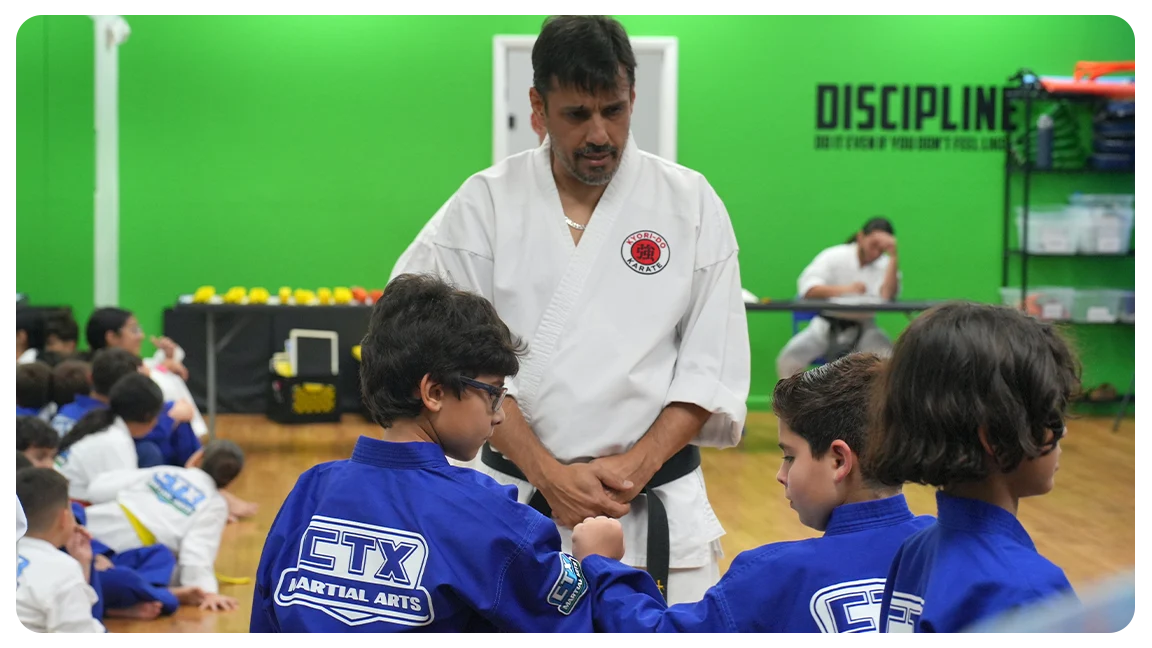
Introduction: More Than Kicks and Punches
Kyori-Do karate is a philosophy, not just a collection of techniques.
Kyori-Do emphasizes three core principles: timing, distance, and honor. These aren't abstract concepts—they're practical tools that define how effective martial arts becomes, and how those principles apply far beyond the dojo.
This guide explores Kyori-Do philosophy and how these principles transform both martial skill and life approach.
---
Part 1: Timing - The Most Powerful Tool
The Principle
Timing beats strength. Speed beats muscle.
A 5'2" person with perfect timing defeats a 6'3" person with raw power. Timing allows smaller people to overcome larger ones, older students to out-technique younger ones, and weak strikers to become devastating.
How Timing Works in Karate
In striking:
- Wrong time: you punch when opponent is moving away (no power transfer)
- Right time: you punch exactly when opponent lunges forward (impact is magnified)
In blocking:
- Wrong time: you block after the attack connects (too late)
- Right time: you block at the moment opponent begins movement (interception)
In sparring:
- Wrong time: you're thinking about your next move (too late, opponent already moving)
- Right time: you read opponent's movement and respond instantly
Training Timing
Timing isn't innate—it's trained through thousands of repetitions.
Methods:
- Kata (forms): practicing against imaginary opponents
- Partner drills: reading partner's movements
- Sparring: responding to real, unpredictable opponents
- Timing drills: specific exercises to build speed/recognition
Years of training rewire the nervous system so timing becomes automatic.
Timing in Life
Beyond martial arts, timing applies everywhere:
In career: Timing your job change when opportunity exists is more powerful than job hunting without opportunity
In relationships: The timing of vulnerability and truth-telling matters more than the words themselves
In learning: Introducing complexity at the right developmental stage creates mastery; too early creates frustration, too late creates boredom
In business: Entering market at the right time creates success; right product, wrong timing fails
The Kyori-Do Lesson
Master timing and you master efficiency. You accomplish more with less effort. You defeat larger obstacles through precision rather than force.
---
Part 2: Distance - Geometry Over Strength
The Principle
Distance is safety. Distance is power.
Maintain proper distance from opponent and you're safe. Close distance correctly and you generate maximum power. Lose distance awareness and you're vulnerable.
How Distance Works in Karate
Too close:
- You can't generate power (no room for technique)
- Opponent has leverage
- You're inside their guard
- Limited options
Too far:
- Technique doesn't reach
- You're slow to respond
- Lots of time for opponent to react
Optimal distance (Kyori):
- You can generate full power
- Opponent can't generate power
- You have options (advance, retreat, strike)
- You see everything
Training Distance
Distance training involves:
- Footwork (moving in/out while maintaining safety)
- Spacing awareness (knowing your reach vs. opponent's)
- Range adaptation (striking from different distances)
- Timing + distance (they work together)
Hundreds of hours develop distance sense until it becomes intuitive.
Distance in Life
Beyond martial arts:
In communication: Physical distance affects how people hear you. Distance (metaphorical) in confrontation matters—too close is defensive, too far is cold
In boundaries: Professional distance maintains respect. Personal distance invites intimacy. Wrong distance creates problems.
In strategy: Business distance from competitor allows you to observe and adapt. Too close leads to reactive conflict.
In learning: Teaching distance (neither too easy nor too hard) is optimal learning
The Kyori-Do Lesson
Master distance and you control situations without force. Position matters more than power. Geometry trumps strength.
---
Part 3: Honor - The Core Principle
The Principle
True martial arts is grounded in honor and integrity.
Without honor, martial skill becomes brutality. With honor, martial skill becomes art and wisdom.
Honor in Training
Kyori-Do emphasizes:
- Respect: Bowing to opponent acknowledges their humanity and courage
- Restraint: Having power and choosing not to use it is the ultimate display of control
- Continuous improvement: Excellence is a journey, not a destination
- Teaching others: Sharing knowledge elevates the entire community
- Admitting limitations: Honest assessment of where you stand
- Following rules: Discipline is choosing structure over impulse
Honor in Technique
In Kyori-Do, techniques are performed correctly, not brutally.
- Power is controlled (you can hurt someone; choosing not to demonstrates mastery)
- Forms are precise (sloppy technique shows disrespect to the art)
- Sparring is respectful (opponent is partner, not enemy)
- Teaching emphasizes fundamentals (rushing to advanced techniques dishonors the basics)
Honor in Life
The honor principle extends beyond martial arts:
In work: Doing your job excellently, not cutting corners, regardless of who's watching
In relationships: Keeping promises, being honest even when it's uncomfortable, respecting others' boundaries
In competition: Competing hard while respecting your competitor
In conflict: Standing up for what's right while respecting the person you disagree with
The Kyori-Do Lesson
True strength is demonstrated through restraint and honor. A person who is powerful but controls that power is more impressive than a person with no control. Discipline means choosing the right action over the easy action.
---
Part 4: How These Principles Work Together
Timing + Distance + Honor = Martial Excellence
None of these principles work in isolation.
Timing without distance: Perfect timing, wrong distance = no effect
Distance without timing: Perfect distance, wrong timing = too slow
Techniques without honor: Powerful, disrespectful = brutality, not martial arts
Together, they create true skill.
In Training
A Kyori-Do student learns:
- 1Distance first (footwork, spacing, positioning)
- 2Timing second (reading movements, responding precisely)
- 3Technique third (applying distance + timing together)
- 4Honor throughout (respecting the art and training partners)
Years of this training create a martial artist who is:
- Effective (timing + distance work)
- Humble (understanding they'll never master everything)
- Controlled (choosing not to use excessive force)
- Respectful (toward training partners and opponents)
Real-World Examples
Small person defeating large person:
- Distance: stays just outside reach
- Timing: strikes when opponent extends
- Honor: uses only necessary force, stops when opponent concedes
Experienced person defeating young person:
- Distance: controls space
- Timing: reads youth's telegraphed movements
- Honor: trains youth to improve, not just defeats them
De-escalation in conflict:
- Distance: creates safety zone (not too close, not running)
- Timing: speaks calmly when opponent is listening (not mid-rage)
- Honor: respects opponent's dignity while establishing boundaries
---
Part 5: Kyori-Do Values in Daily Life
Courage
Not fearlessness, but acting despite fear. Kyori-Do teaches that courage is choosing the difficult right action.
Discipline
Discipline isn't punishment—it's choosing structure over impulse. Train every day, even when unmotivated. Do the right thing even when unseen.
Respect
For instructors who guide you, peers who challenge you, opponents who test you, and even your own body and limits.
Integrity
Your word means something. Your actions reflect your character. You do the right thing because it's right, not for recognition.
Humility
The more skilled you become, the more you understand how much you don't know. A black belt understands there's always more to learn.
Community
Martial arts is a journey you take with others. You lift up your community as they lift you up.
---
Conclusion: A Way of Life
Kyori-Do philosophy transcends martial techniques. It's a way of approaching life:
- Timing: Act at the right moment with the right precision
- Distance: Maintain healthy boundaries while staying connected
- Honor: Conduct yourself with integrity and respect
These principles, practiced daily in the dojo, become habits in life. You become someone who understands that true strength is demonstrated through restraint, that precision beats force, and that how you treat others defines your character more than what you achieve.
That's Kyori-Do—martial excellence grounded in philosophy and honor.