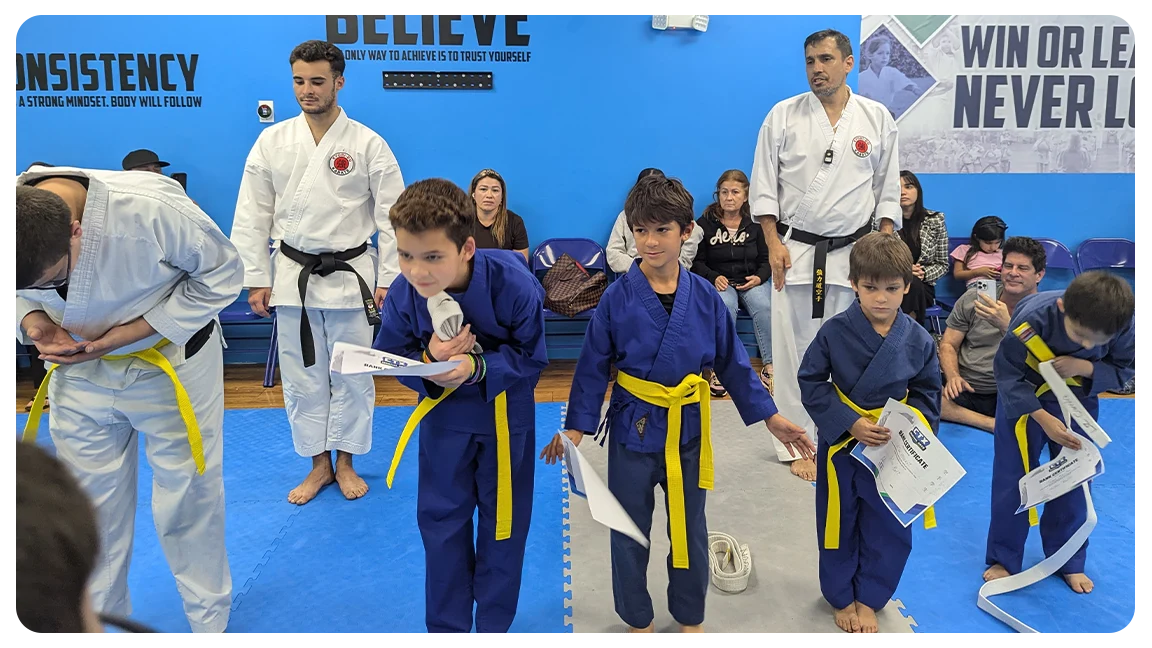
# The Belt Progression Journey: How We Help Children Master Karate at Their Own Pace
By Sensei Nicholas Pita, Senior Instructor at CTX Martial Arts
Parents ask me this question regularly: "How does belt progression work in karate? How long until my child earns a black belt?"
It's a great question, and the answer reveals a lot about the philosophy of martial arts training—and how we approach child development at CTX.
Why Belt Systems Exist
Belt progression isn't just a ranking system. It's a carefully designed learning pathway that serves multiple purposes.
First, it provides structure and clear goals. Children thrive with visibility into what comes next. When a student knows what skills they need to master for the next belt, they focus their training. They set personal goals. They see themselves progressing, not just showing up to class.
Second, belt advancement serves as external reinforcement of genuine progress. In a good belt system, you don't advance until you've genuinely mastered the previous level. This teaches children that achievement requires actual competence, not just participation.
Third, the journey toward black belt—often taking 2-4 years—teaches patience, persistence, and long-term thinking. In a world of instant gratification, martial arts is one of the few disciplines where children invest years in mastering a craft.
The CTX Belt Progression Path
At CTX Martial Arts, we structure belt progression around skill mastery, not time. Your child doesn't advance because they've shown up for 6 months. They advance because they've mastered the skills of their current belt level.
Here's how it typically works:
White Belt → Yellow Belt
Students begin as white belts and work on fundamental stance, basic punches and kicks, foundational kata (forms), and character development basics. This usually takes 2-3 months of consistent training. During this phase, we're building the foundation—teaching the "language" of martial arts.
Yellow through Green Belt
As students progress through the colored belt ranks, they add complexity. New techniques are introduced. Kata becomes more intricate. Self-defense applications are taught. We also increase expectations for focus, respect, and class participation. This phase typically spans 4-6 months per belt level.
Green to Brown Belt
Advanced colored belts require deeper mastery. Students are refining technique, teaching newer students, demonstrating understanding of principles (not just memorizing moves), and showing character development. By brown belt, a student is preparing for the biggest milestone: the journey to black belt.
Brown Belt to Black Belt
This is where the work deepens significantly. Brown belt students are training 3-4 times per week typically, working on perfection of technique, demonstrating teaching ability, and showing genuine transformation. The path to black belt takes commitment. It typically requires 6-12 months of intensive training, a comprehensive black belt test, and demonstrated character development.
What We're Actually Evaluating
When a student tests for the next belt, I'm not just watching them execute techniques. I'm evaluating several things:
Technical Mastery: Can they perform the required kata with proper form? Do the techniques work? Do they understand the applications?
Character Development: Are they showing respect? Are they a good training partner? Do they help newer students? Have they grown in discipline and focus?
Teaching Ability: Can they explain a technique to another student? Do they understand the "why" behind movements?
Consistency and Commitment: Are they training regularly? Are they showing up even when it's hard? Do they take their practice seriously?
A student who can perform all the techniques but shows no character growth doesn't advance. A student with great character who's sloppy technically might need more time. Real advancement requires growth across all dimensions.
Why Your Child's Pace Might Be Different
Here's something I want to clarify for parents: there's no "normal" timeline for belt progression.
A 6-year-old learning martial arts for the first time might need 3-4 months to earn their second belt. A 10-year-old who's naturally athletic might move quickly through colored belts but hit a wall at brown belt when the intensity increases. A shy 7-year-old might take longer to progress technically but show extraordinary character development.
This variation is healthy. We're not manufacturing black belts on a schedule. We're developing martial artists—and every student's journey looks different.
What matters is consistent progress, not speed. A student who trains twice a week, shows up prepared, and puts genuine effort into mastery will eventually reach black belt. The timeline might be 2 years or 4 years, but they'll get there.
What Parents Should Watch For
As your child progresses through belts, watch for these genuine markers of growth:
- Increased Technical Confidence: Your child can demonstrate techniques without someone guiding them. They remember their kata without prompting.
- Improved Class Focus: Your child sits attentively during instruction and follows directions. They're not distracted or checked out.
- Better Self-Control: Your child shows improved impulse control both in class and in life. They think before acting.
- Respect Development: Your child speaks about their instructors respectfully. They listen and follow feedback.
- Peer Help: Your child helps newer students without being asked. They enjoy seeing others succeed.
If you're seeing these changes, your child is progressing on the right track—regardless of how many belts they've earned.
The Difference Between Advancing and Growing
Here's the distinction I want to make clear: earning a belt and experiencing genuine growth are different things.
I've seen students earn a black belt because they could technically execute all the requirements. I've also seen white belts who weren't pursuing advancement but showed more genuine character development than advanced students.
Ideally, they overlap. Your child advances when they've genuinely grown—technically and as a person.
At CTX, we structure progression so advancement requires both. You don't earn the next belt without proving your technique. You also don't earn it without demonstrating character growth and genuine commitment to the discipline.
Setting Expectations for Your Child
If your child is starting karate at CTX, here's what you can realistically expect:
- First 2-3 months: Your child will learn fundamentals, build basic confidence, and get comfortable in the training environment. Advancement to the first colored belt typically happens here.
- Months 4-12: Progression continues through colored belts. The pace slows a bit as techniques get harder. This is where commitment is tested. Some kids train consistently; others fade. Those who stay usually advance every 2-4 months.
- Year 2: If your child is training consistently, they're progressing toward advanced colored belts. You'll notice they're teaching other students, taking class more seriously, and showing real skill.
- Years 2-3+: Black belt is in reach for serious, consistent students. The path gets harder, but the transformation by this point is usually remarkable.
This isn't a race. We've had 60-year-old adults and 5-year-olds training together. Each progresses at their natural pace.
The Real Metric of Success
Parents sometimes ask: "When will my child earn their black belt?"
My answer: that's not the right question.
The right question is: "Is my child growing? Is their confidence increasing? Are they developing discipline and respect? Are they becoming the kind of person who follows through on commitments?"
Belt progression is just the visible metric of those deeper changes.
The black belt is a symbol of having put in the work. But the real achievement is becoming the kind of person who has the discipline to master something difficult. That's what we're building at CTX.
---
Sensei Nicholas Pita is a Senior Instructor at CTX Martial Arts with 16 years of martial arts experience. He specializes in working with children in the Little Dragons and Junior Dragons programs, where he's helped hundreds of children discover confidence and develop character through karate training.