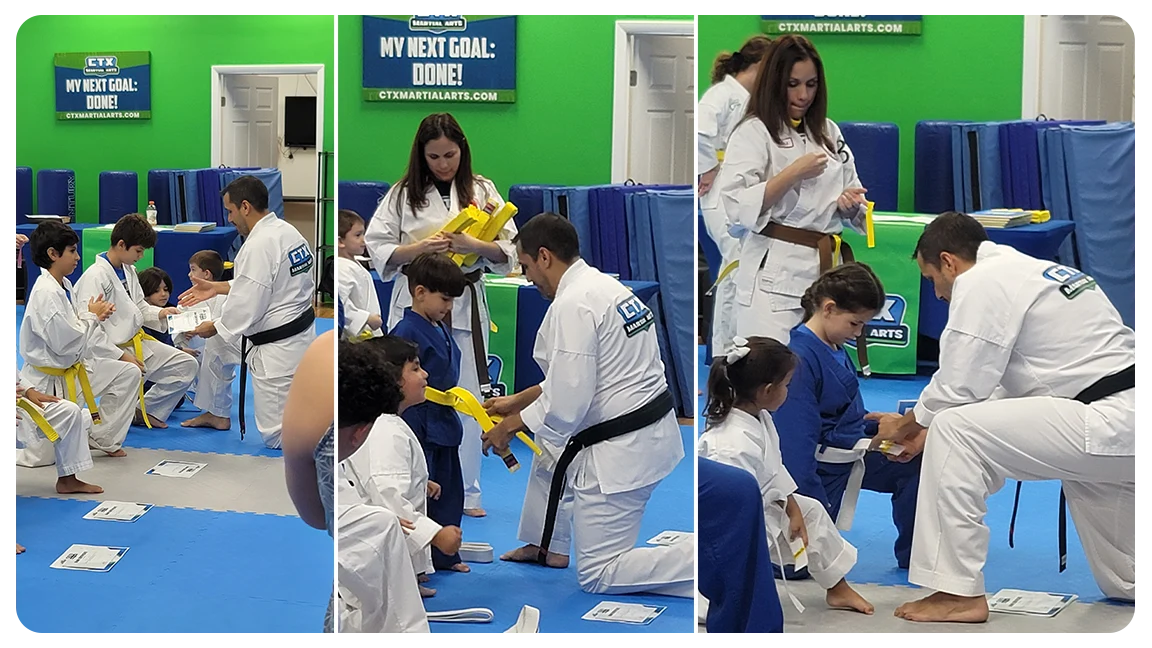
What is Belt Testing?
Belt testing is the formal evaluation where a student demonstrates mastery of material at their current level and readiness to advance. It's not just a test—it's a significant milestone that represents months of training and growth.
Belt testing is different in different schools. Understanding what testing means at your school is important.
The Testing Process
Eligibility: Students train for a specified period (typically 2-4 months) before testing eligibility. This ensures adequate preparation time.
Announcement: Sensei Luis announces that you're ready for testing (or you can request testing if you feel ready). This happens naturally through our structured curriculum.
Preparation: The testing requirements are clearly defined. You know exactly what techniques, forms, and knowledge you need.
The Test: You demonstrate the required material in front of the sensei and sometimes a testing board.
Feedback: You receive feedback on your performance.
Result: Pass or no-pass (or occasionally "not yet ready, continue training").
What Testing Measures
Belt testing measures:
- Technical Skill: Can you execute techniques correctly?
- Knowledge: Do you understand principles and terminology?
- Consistency: Can you perform under pressure?
- Improvement: Have you improved since your last test?
- Attitude: Do you demonstrate respect, effort, and appropriate mindset?
Common Testing Components
Techniques: Demonstrate kicks, punches, blocks, and combinations with proper form and power.
Forms (Kata): Perform memorized sequences that demonstrate style, control, and understanding.
Sparring: Demonstrate skill in controlled sparring with appropriate technique, control, and strategy.
Board Breaking (optional): Demonstrate power and focus through controlled breaking.
Knowledge Questions: Answer questions about technique, terminology, and martial arts philosophy.
Physical Conditioning: Demonstrate fitness and endurance appropriate to your level.
How to Prepare
Training Consistency: Regular training is your primary preparation. Attend every class possible in the month before testing. This aligns with advanced technique training where preparation becomes more focused.
Extra Practice: Dedicate additional time outside class to drilling techniques and forms.
Mental Preparation: Visualize successful testing. Practice executing under pressure.
Physical Conditioning: Ensure you're rested, fed well, and physically prepared.
Understand Requirements: Know exactly what's required. Review the testing checklist multiple times.
Ask Questions: If you're unsure about anything, ask Sensei Luis or advanced students.
Managing Test Anxiety
Test anxiety is normal. Even experienced martial artists get nervous during testing. Here's how to manage it:
Remember Your Training: You've trained for this. Your body knows what to do.
Focus on Process: Rather than worrying about results, focus on executing each technique correctly.
Breathe: Controlled breathing calms the nervous system.
Reframe Nervousness: Nervousness means you care. Channel that energy into focused effort.
Trust Your Preparation: If you've trained consistently, you're ready.
What Happens if You Don't Pass?
Not passing happens. It's not failure—it's feedback. You continue training and test again. Most students who don't pass on their first attempt pass within a few weeks of additional training.
"Not yet ready" is actually valuable information. It tells you where to focus your training.
The Test Experience
Most students report that the actual testing is less intimidating than anticipated. The combination of training preparation and support from your dojo community creates confidence.
Many students report that testing—even with nervousness—is one of the most rewarding experiences. You demonstrate what you've learned. You receive recognition for your achievement. You advance to your next level.
Testing at CTX Martial Arts
At CTX, testing is:
- Clear: Requirements are explicitly stated
- Fair: Evaluation criteria are consistent
- Supportive: Sensei Luis and the community support your success
- Meaningful: Belts are earned through real achievement
When you earn a belt at CTX, it means you've genuinely achieved mastery at that level.
Your First Test Awaits
Your belt testing journey starts with your first training class. As you progress, you'll approach your first test. It will be challenging. It will also be one of the most rewarding experiences of your training. Eventually, dedicated students work toward black belt goals and the testing that accompanies that journey.
Your first week of training is free at CTX Martial Arts in Kendall, Miami. Visit our schedule to find a class that fits your goals. Learn about competition training if you're interested in the competitive path alongside belt testing. Your belt testing journey—and your real achievement—begins now.